Showing posts with label saint-remy. Show all posts

07 September 2011

Provençal Lass 2: Abandonment Issues


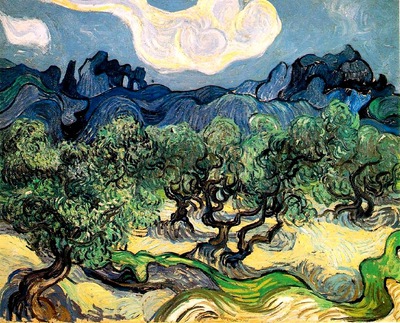
If you crossed the olive grove from the asylum of Saint Paul-de-Mausole (as Van Gogh may have done while he lived there) past the scene painted in Olive Trees with the Alpilles in The Background, you might be startled by this sight.


And this.


For two millenia, these were the only visible remnants of an ancient Roman city that was still buried in Van Gogh's time, and so escaped the wild representation of his brush. But, had he known what lay underneath, The Starry Night would have looked very different.

The Mausoleum of the Julii (40 BC) and the Victory Arch (10-20 AD)

The Mausoleum of the Julii (the best preserved mausoleum of the ancient world) and the Victory Arch hinted at the existence of a lost city. In 1921, two men fancied a dig and unearthed an insightful look at the life and times of the ancient city of Glanum.

All roads lead to Rome.
The main throughfare in Glanum was linked to Via Domitia and Via Augusta,
connecting Spain and France to Italy.

I underestimated the size of the city. It stretched so far that the end was hardly visible from the entrance, and yet the excavation is still ongoing. I don't think we have really seen all there is to see.


But from what we know, the path we took is also a trip back in time. From the road that you can see on the left, the Roman city began with a few houses, 


a forum for noblemen, 


a bath house with cold, lukewarm and hot water,

The remaining roof tiles of the baths (75 BC. Rebuilt in marble in 161 AD.)
The mask that spits water into the pool. Classy.

a marketplace,


some temples and chapels,

A temple to Hercules, with podiums for offerings.
The Corinthian Temple
 

mansions,

H spots a doorway and goes straight to work. Old habits.


a public hall for conducting business,


Karate Kid business.

an underground water source,


and most importantly - a sacred well dedicated to the god Glanis or Glan. It was the reason why Glanum was erected in the first place.

H stares down into the sacred pool. I saw something stirring within.

And past certain points, the architecture changes. The layers get older as you go higher and further into the city. 

The Temple of Valetudo, a Greek shrine (39 BC)

The buildings change from Roman to Hellenistic, with an area that overlaps the Gallo-Roman and the Gallo-Greek; after which there appears a gateway, a definite attempt to divide the Romanesque from an older Greek section of Glanum. And then, there is another division - an older section further up which turned out to be the most ancient part of the city.

The end of the road. This is the Gaulish part of Glanum and the tour ends here.
Ironically, it used to be the entrance to the city, and fortifications
were built here to protect from invasion.
The Roman walls were bult over Greek walls which were
in turn built over Gaulish walls.

After the defeat of the Roman Empire, the city fell on hard times. The residents were sacked by German tribes, so they moved to what is now Saint-Rémy-de-Provence. Abandoned, the remains of the formerly well-to-do city was ransacked for stones to build the foundations of the new settlement in 260 AD.


But as I stared at the chalky rocks that loomed over the oldest part of Glanum, I wondered whether the city was much older than 150 BC. It is nestled under a cliff spotted with half-concealed caves that may have been the homes of earlier settlers, who later learned to build much more comfortable dwelling places, who learned to worship and build temples, and learned that certain things - like faith and sacred wells and elixirs of life - could forestall death. And so, they stayed.

There was recent article on National Geographic that puts forward the theory that religion (not agriculture) gave birth to civilization. It was the urge to worship that made man abandon his nomadic ways, and not the discovery that he can cultivate his own food.


But these are just conjectures, so don't take me seriously. One day, the people of Glanum decided the sacred well was hardly worth the effort anymore. And so the city passed on to myth, and then lost.

Plane trees along the "romantic" road to Les Baux (le baw).

Time seemed to stand still while we were there. There were no clouds, the wind did not blow, the sun didn't seem to move. We only realized we stayed for about two hours in the site when we came out, thirsty and weakened by the relentless heat. It was way past noon when we reached another ancient settlement between Saint-Rémy and Arles, this one considerably younger compared to Glanum.

Up Next: The Great Les Baux-sky


Related Posts:
A Year in France Celebration (The Aftermath)
Sizzling Beach 1, Sizzling Beach 2, Sizzling Beach 3
Bella Italia 1, Bella Italia 2, Bella Italia 3, Bella Italia 4, Bella Italia 5
Provencal Lass 1

06 September 2011

Provençal Lass 1: In the Steps of a Madman

We camped for the night at a whistlestop near Portofino. As day turned to night, the lights of the little enclave in the opposite hill flickered to life, and street lamps formed a dotted line going to the cluster of houses on the next hill. There were three young women walking around in their underwear at the campsite for some reason, and the trivial chatter of young Pinoys at the grilling area filled the air, mingling with the smell of roasting sausage.


The next morning, I said goodbye to the Pinoys. In the Philippines, I would have been peeved by their heedless blather, but here in Nowhereland, Italy, it allayed more than annoyed. I miss my peeps. I wished them bonne route back to Turin, and to escape a tedious explanation of our road trip I told them we were going back to Paris. But home was really one more week away.

The road back to France was a long one, I slept part of the way and when I woke up we were in Provence.

H and the unibrow house

EXHIBIT A. Pont d'Avignon.
I've been to a few towns in PACA (Provence-Alpes-Côte d'Azur) a couple of times before, but stayed solo in Avignon the longest in 2009. My visit was virtually stress-free because I didn't have to rush or wait for anyone. I woke up, had my complimentary breakfast, went to the museums and strode to the different landmarks at my own pace.  I could stay at the kitschy Provençal souvenir shops as long as I liked, and "I liked" beaucoup (very much) because I have the design aesthetic of a grandmother and I love the smell of lavender. (Gawd, I'm crazy for lavender!) The only hitch about being unhitched was the high level of difficulty in the picture taking department. See Camwhoring Exhibit A, to your right.

EXHIBIT B.
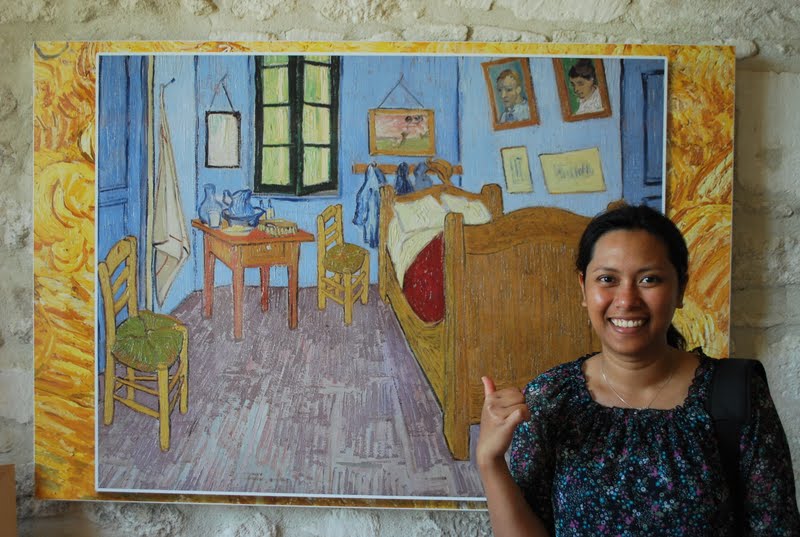
Inside a Van Gogh painting, Arles.
Having a man around while traveling has its pros and cons, but mostly pros. I have to hurry along when we pass by points of interest because he likes sticking to his schedule, but at least now I could be in the picture. However, H's cropping abilities leave much to be desired. Please direct your attention to Exhibit B.

The land of lavender and ceramic cicadas got its name because it was the first Roman province beyond the Alps, but it is much older than the Roman Empire. Primitive Gaulish and Celtic tribes planted themselves here, early civilizations were also established by the Persians and Greeks. But these were nothing compared to the western expansion of the Roman juggernaut.

Coliseum in Arles
Where a Johnny Halliday concert
was to be held the same night.

The Arenee in Nimes
Where men still fight bulls.

It's amazing enough to see Roman ruins here, especially considering how accessible they are in modern France. You could be in a totally chic urban center and suddenly be face to face with something older than Christianity. Some are still standing - like the arenas in Nimes or Arles, or the world's best preserved antique theater in Orange (where we saw the Spring opera). Even nearly-lost ruins, like the Arenes de Lutece in Paris where kiddie soccer has replaced circus acts and bloody spectacles, can still astound for their sheer resilience. But, it is something else entirely to see a whole abandoned city. Later on this trip, H and I would stumble into one of the best archaeological sites of the ancient world --

But, I'm getting ahead of myself here. First, allow me to tell you about Saint-Rémy.

There are many reasons to visit this town on the Alpilles (little Alps). If you are a fan of astrology and the occult, the man who used to live here would be familiar.


This was the birthplace of Michel de Nostredame, the Jewish physician more popularly known as Nostradamus.


When I was in my early teens, a movie about Nostradamus' indisputable predictions was very popular on Betamax and VHS. It was narrated by no less than the great Orson Welles, and it scared the pants out of me. This was during the Iraq War, and there was an End-of-Days pandemic. The prophecies of Nostradamus were allegedly coming true; according to the movie's dramatic portrayal, some guy in a blue turban was supposed to sow terror in the New World. I think he meant the Smurfs.


The Saint-Rémy of Nostradamus in the Renaissance didn't look so different from the Saint-Rémy of today, with the exception of a few details.


Another popular name is etched on this extensive mansion a few streets away from Nostradamus' house.


It is the Hôtel de Sade, an archaeological museum for important finds from the ruins of the ancient city of Glanum. And although the name might be infamous, they were only distant relatives of the notorious agent provocateur, Marquis de Sade.

But for sightseers, one name stands apart from all others. For some, walking in his footsteps is the sole reason for coming here at all. And I suppose for some people that can be so annoying, enough to put up a sign like below --


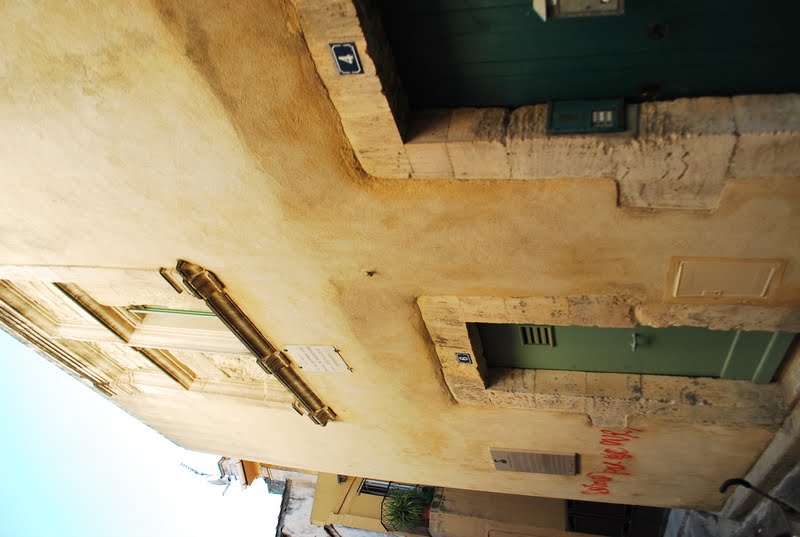
In French, the sign reads: "Van Gogh wasn't born in this house. He didn't die here either."


Saint-Rémy has an extreme case of the hots for Vincent Van Gogh, and the feelings were mutual. The tortured painter stayed just a year here but made 150 paintings inspired by the town before he moved to Auvers-sur-Oise, where he shot himself two months later.

The lavender field in the back. See the painting here.

Sunflowers. I wonder if they made him as happy as they make me.

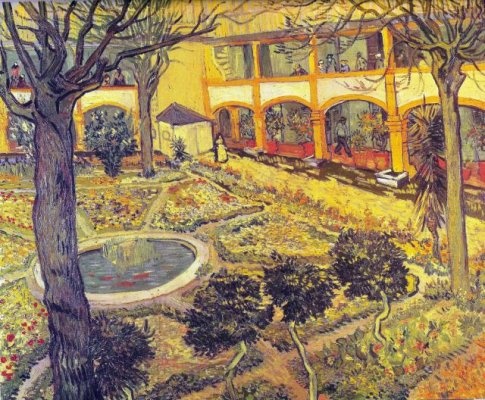
Saint Paul-de-Mausole is a former monastery that was turned into an asylum. Except for the two rooms that Van Gogh occupied and the cloister of the wing where he stayed, the rest of the hospital is still accepting patients up to this day.

The artist's spartan room
Actually, I think this was his bedroom in Arles, when he cohabited with Gaugin.
I'm no art major, I only know this from the movie so correct me if I'm wrong.
The peaceful cloister. See painting here.
H catches me resting my tired old feet.
The actual olive trees from the painting.

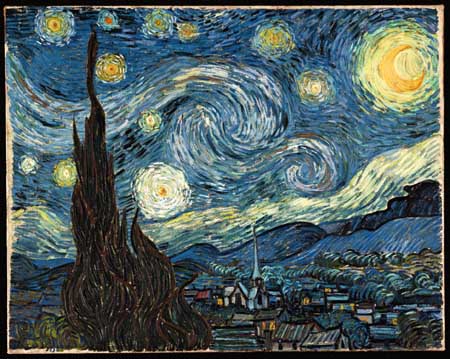
The asylum where he stayed and its surroundings were the subjects of many of his paintings. This was his swirly period, when in his pain he produced the most exquisite works of his short artistic life. His most famous subject, his most famous painting of all, was the town of Saint-Rémy. It is the haunting star-lit burg in La Nuit étoilée, The Starry Night.

From Codart.nl

On our first night in Saint-Rémy, we dined under the stars. The clear black sky was perfect for stargazing. I lay on our quilt and clutched my glass of wine as if it were an anchor, in case I got swept away by the celestial stream. I brought out my watercolors just in case the muse would visit me here, but of course my sophomoric attempts at painting cypress trees did not produce anything as haunting as Van Gogh's Cypresses. Maybe the great car debacle of 2011 didn't torture me enough; or maybe I should consider shifting to oil painting. Haha, as if.

The following day gave me the torture I was looking for. From Saint Paul de Mausole we walked to the nearby ruins of Glanum and unconsciously spent two hours inspecting every inch of the abandoned city of the western Roman empire. From the top, we saw this - Saint-Rémy, as it looked in The Starry Night.


Up Next: Glanum to Meet Ya


Related Posts:
A Year in France Celebration (The Aftermath)
Sizzling Beach 1, Sizzling Beach 2, Sizzling Beach 3
Bella Italia 1, Bella Italia 2, Bella Italia 3, Bella Italia 4, Bella Italia 5
Related Posts Plugin for WordPress, Blogger...

Most Read