31 March 2011

First Class Beach

In a hole in the ground, there lived a killing machine. 


These are just some of the entrances into the vast network of tunnels built by the Germans in Mont Canisy, the highest point on the shores of Normandy. We went there two weeks ago, but I was too busy finishing all three seasons of Being Human to blog about it :)

H had to visit a factory in Caen one Friday, and I of course did not pass up the opportunity to see the famed Normandy coast. 


First, he dropped me off at Caen so I could "do my tourist thing" while he worked. There was a slight drizzle in the afternoon but there was enough sun in the morning to allow me to discover some places on foot, starting with what remains of William (Guillaume) the Conqueror's castle in the Chateau Ducal. 

It's on a hill overlooking the city, and this is what you can see to the west from the top of the ramparts:


The castle itself is gone, and these are the parts that remain. A few towers, the vestiges of a dungeon and the bones of walls long gone. But here once stood the throne of the King of England and concurrent Duke of Normandy.


The Musee des Beaux Arts, Chapelle Sainte-Georges, Musee de Normandie and a small park can also be found within its walls. 


Then I went window shopping along Rue Saint-Pierre, and saw this pair of interesting buildings with intricately carved facades. They date back to the 15th century, and are the oldest pieces of architecture on the strip. It's a good thing they survived the bombings in Normandy.


The ornate carvings on the timber frames are amazingly well preserved, it's too bad that by this time the camera's battery had died and I had to rely on my cellphone.

It's all in the details.
A few blocks down is the Église du Vieux Saint-Sauveur. It's close to the plaza, where I had a Nutella crepe and found a vinyl "Thriller" album at the street market.


There are two abbeys in Caen: the one to the east is the Abbaye-aux-Dames for the ladies, and the one to the east is the Abbaye-aux-Hommes for the men (pictured below). Interesting thing I dug up from the internet: the abbeys were built in the 11th century as penance for William marrying his cousin Matilda. Strange, the things money can buy.


The warpy thing the towers seem to be doing is just my phone being weird. It's my Chrestomanci moment.

The cathedral-looking building is the St. Etienne (St. Stephen's) Church, which was a refuge for citizens during the invasion in WWII. Inside is William's tomb, although not all of him is buried there.


All that's left is a femur, recovered after Protestants opened his tomb and scattered the bones. And there it rests still.


Across the street from the Abbaye-aux-Hommes is the "old" Église Saint-Étienne-le-Vieux. It was destroyed in WWII and never rebuilt.


Along the cafe strip I settled for Cafe Latin, the bartender was really nice and listened patiently while I ordered in horrible French. It's gloomy and dark inside, and a Google reviewer called the interiors "moche" or ugly, but I think it has personality.


H and I stayed the night at S's house, near the Deauville Hippodrome. The next day we went hiking to the highest peak on the beaches of Normandy, Mont Canisy. From here, you can see the Seine emptying out towards the Atlantic. You can also see some of the many bunkers abandoned after the Second World War.


S showed us where he and his brother used to play cowboys and indians. 


From this angle, you can clearly see ships coming in from England. 


Just imagine how big the cannon was. And there was more than just one. The Allies bombarded the site, but none of the guns were damaged.


Closer to the beach, they could put snipers in this underground tunnel, which nature seems to have reclaimed.


Not far from this sad menagerie of war relics is the posh village of Deauville. Here, affluent Parisians have spent idle weekends riding horses or relaxing in their beach houses since the 1800s. It was part of the Proust's inspiration for Balbec in Remembrance of Things Past.


Dressing up in your sunday Gucci for a walk in the Promenade des Planches has been a common pastime since the 20's. It's where Tom and Daisy from the Great Gatsby spent their honeymoon.  


And in the summer, the A-List descends upon the beach for the Deauville Film Festival, or watch the races at the Hippodrome, or throw a wager at the club that inspired Casino Royale.

From Wiki.


But for that weekend, the only high-flyer you could see was this rainbow-striped one, which reminded me of my socks.


And for now I think that's the last of the beaches I'm going to cover ;)

15 March 2011

Frigid Beach 3

The weather report didn't stop us from going to the beach again this sopping wet weekend - this time to the coasts of Vendée and Charentes in the west. 


First to the soft, golden sands of La Tranche-sur-Mer (south Vendée) and then to historic harbor of La Rochelle (Charentes), both facing the Atlantic.


M, H's friend from law school, drove to La Tranche with his wife and baby for some peace and quiet before their big move to China. H and I did not have time to visit them in Rouen like we promised after New Year's, so we decided to visit them there instead. 

This resort town is packed in the summer, with people pouring in for the Déferlante festival, and of course the great sunny weather to be had.  But the sun was nowhere to be found and the town looked deserted that weekend, so water sports was the last thing on our minds. 

This road leads to the beach. Beyond that arch in the back is the Atlantic Ocean.
Good thing at least one snack shop was open, and the house was stocked with food and drinks for a night of drinking various brews and spirits that inspired me to invent cork Jenga (pictured), and earned someone the nickname "Space D*ck"... Ok, it was me. Long story. 


It rained all morning the next day, but lucky for us the clouds parted "un petit peu" as we reached La Rochelle, which was three swamp towns away. (About an hour's drive from La Tranche-sur-Mer.)


Some luck with the weather, at last!


La Rochelle is a thousand years old, and is featured a number of times in our study materials at Alliance Française. 

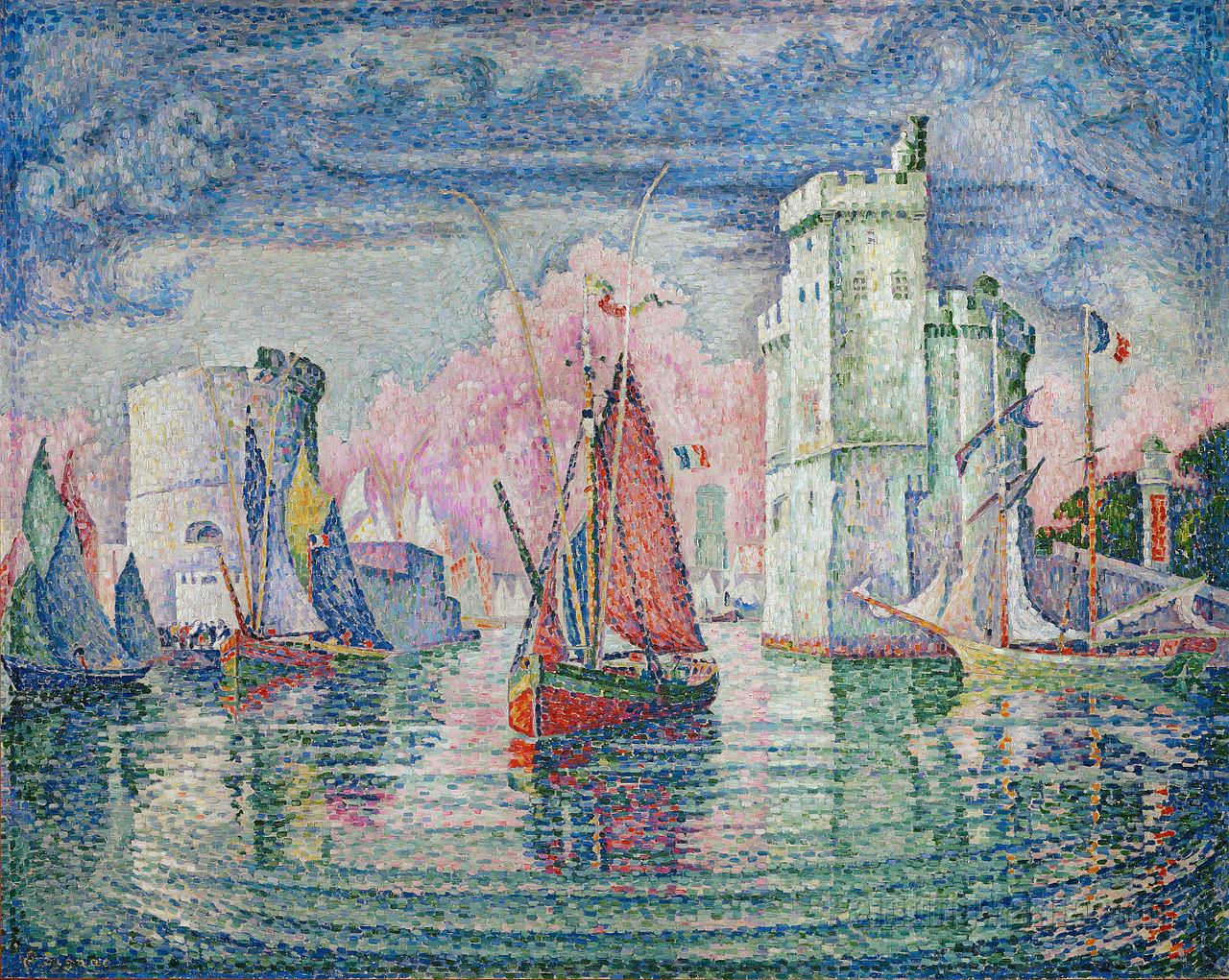
Port of La Rochelle by pointlist Paul Signac (1921). Displayed at the Musee D'Orsay.

It's one of the most beautiful cities in France, and one of the few that kept its medieval architecture practically intact as perhaps evidence that the harbor walls were highly effective in keeping the money in and the enemies at bay. 


The templar knights kept base here, and for centuries English, French and Spanish armies would battle over control of La Rochelle for political, economic and religious reasons.


Three towers distinguish this harbor: the Saint-Nicolas military tower on the right; the Tower of the Chaîne which controls the passage of vessels into the port; and the Tower of the Lanterne at the left, which is the only surviving mediaeval lighthouse on this coast. 


From any angle, it looks more like a church tower than a lighthouse.

Picture by H

The port is as popular for its good restaurants as it is for the views. We strolled down the harbor and went on a promenade inside the Quartier de la Chaine, then said a prayer at the 12th century Eglise Saint-Sauveur which, one blogger quipped, is the unluckiest church in La Rochelle. It was burned and attacked so many times that it ended up looking like this. 

Photo by H. 
Even with recent restoration efforts it still looks like an unintentional Gaudi. In fact, it reminded me of the opening sequence of Bob's Burgers. (If you've seen the series, bravo to you.)

Then we rewarded ourselves with a gaufre (waffle) and crepe before driving over to the bridge towards Ile de Ré just in time for sunset.


I should mention the Futuroscope trip here too since it's in the area, but technically it's not in a beach so I'll save that story for later :)

Up Next on Frigid Beach: Normandy?

03 March 2011

Frigid Beach 2

Now we move on to the north west, to the Aquitaine coast. It's the basque region of France (on the border of Spain) and is allegedly the best surf turf in Europe. H had business in Bordeaux so I tagged along. 

Photo by H

The cliff walk was pretty dangerous because it was purely sand. This was during sunset, and the fog was slowly eating up the scenery next to me. 


The advantage of living here is the convenience of having the snow-covered Pyrenees to your west and a  number of good beaches to your north. And if your sole purpose of going to the beach is sunbathing, you don't have to worry about finding a place in the sand at Arcachon.

Photo by H

The Great Dune of Pyla or Dune du Pilat is a massive sandbar piled 107 meters high. It's a nice place to pretend you're in the desert... before tumbling off into either the pine forest or the Bay of Biscay.

From Travel.smart-guide.net
Further south, from the ancient port of Saint-Jean-de-Luz, you can spy the tops of La Rhune and the peaks of the Pyrenees from this spot at the lighthouse.


This Basque town is on the pilgrimage route to Santiago de Compostela. 


This was my second time in Basque country, the first time was with a TV crew a few years ago.


15 lbs later, I came back - this time on the French side of the fence -  to get some chow!


Or eat, drink, pig out.


We had lunch at Bodega La Plancha, which wasn't in the Pays Basque (Basque Country) guidebook, but it was full of locals and Spanish tourists so we took it as a good sign. Esta muy delicioso!

Competing with Saint-Jean-de-Luz for tourists is Biarritz, which is known for its mad, mad waves.


It's a popular town for sailing enthusiasts and beach lovers, but it's also known for being pricey. The town center has nice shops and I fell in love with a dress that was way out of my price range, so I drowned my sorrows with a glass of juice and a gateau Basque.

The Grand Plage (big beach) is behind the big rock on the left.
It's surrounded by cafes, restaurants and glace (ice cream) stalls so you can get a bite to eat even in your swim wear.
We went on a side trip to hopelessly cute Bayonne for a bottle of wine and to say a little prayer at the Cathedrale Sainte- Marie... sorry, no pictures without us ruining the scenery!!!


Bayonne's architecture is a mix of Basque, Roman and Gothic. During the Fetes de Bayonne, the people continuously drink for 5 days, release some cows in the streets and let God sort them out. It was the Jews who made Bayonne the chocolate capital of France.


While in Aquitaine, we squatted with H's friends who lived in Labenne, a quiet neighborhood with a street that leads straight to the beach.

Radical, dude.
There were more bunkers on this beach. As I mentioned in Frigid Beach, the Germans used to hole up in these things to ambush the Allied Forces... only the enemy never came. Decades later, it's like Planet of the Apes.


The waves were huge but inconsistent so all we could do was play chicken with the sea foam.

I tried to be last to run.

And we played with S's baby.
Darn cute.

28 February 2011

6 months baby, yeah!

We've made it through the half-year mark!


And already I feel nostalgic.


My lovely nanay.


G, in her equally successful blue and piña motif.


C reads for us at the chapel.


H's mom can't contain her tears. Neither could H.


My brother and cousin, shouting "Mabuhay ang bagong kasal!" through the streets of Gigouzac.


Our flight attendants announcing that cocktails are over.


And dinner would soon be served.


J oversees passport and ticket check.

And although I know I'd be hunted down for this, I can't help but wonder who's next?


V & A?


J & A?


Or my cousin and his movie idol? 

Chika lang, A and J!!! There was a bevy of awesome twosome pictures :)
Related Posts Plugin for WordPress, Blogger...

Most Read